Model cooperation at Cloopen; Big 4 friend Paul Atkins
The Cloopen case is touted as a model for SEC Enforcement cooperation. There's more to it. The horse race is over and libertarian poster boy Paul Atkins wins the SEC Chair derby.
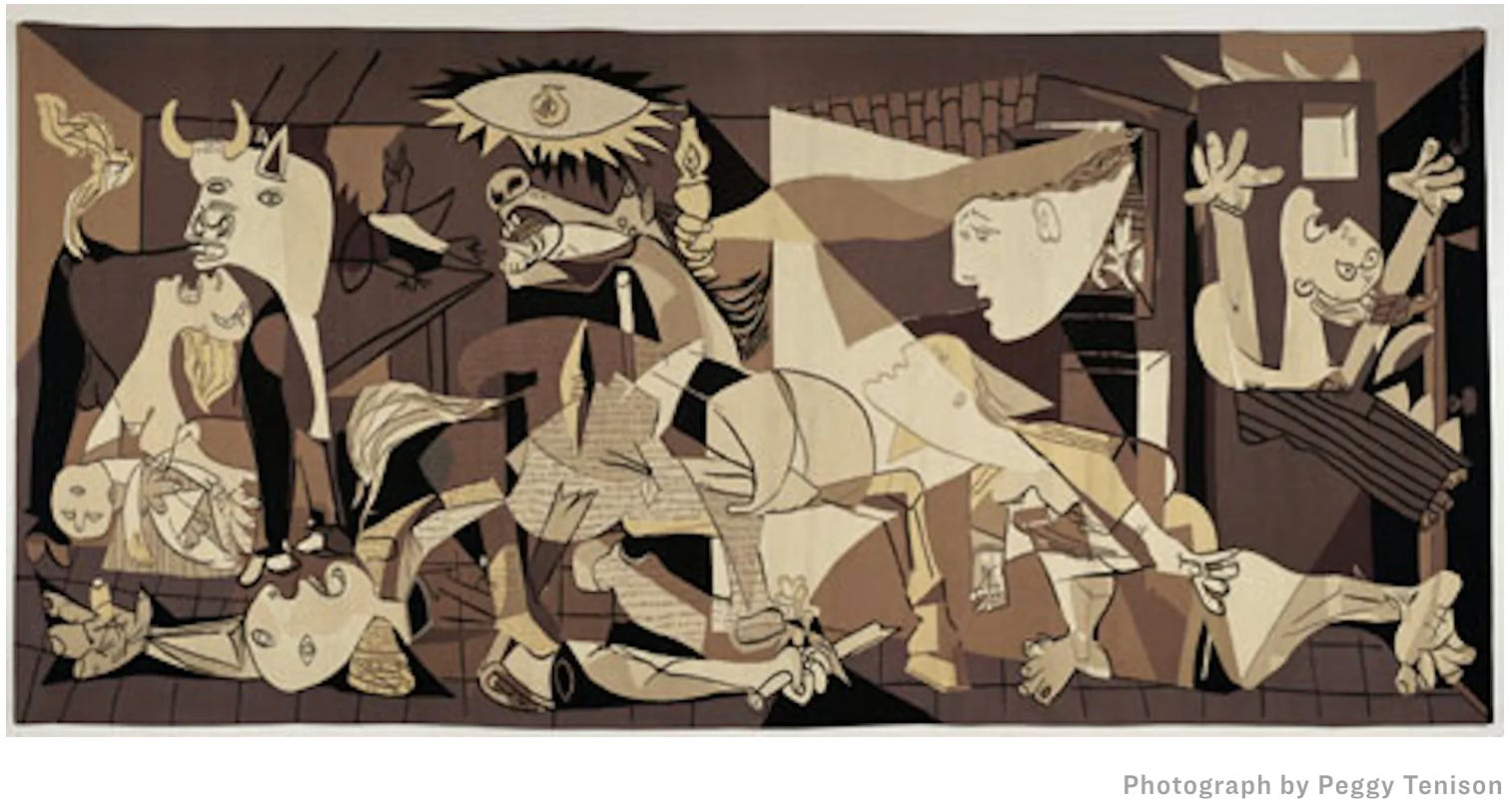
A German officer visited Picasso in his Paris studio during the Second World War. There he saw Guernica and, shocked at the modernist “chaos” of the painting, asked Picasso, “Did you do this?” Picasso calmly replied, “No, you did this!” Slavoj Žižek, Violence: Six Sideways Reflections
I wrote back on November 24 that the Financial Times had reported KPMG's reputation in the U.K. had come a long way in being rehabilitated.
Side dishes: More Super Micro, Rapoport on tax, SEC Enforcement statistics, and Buffett's cash
Too bad the Harris/Walz campaign did not know this literature!
The failure of U.K. outsourcing company Carillion, in particular, had been "a reputational and financial catastrophe," according to the FT, "resulting in a record regulatory fine and contributing to a temporary withdrawal from bidding on government contracts."
Carillion failed in January 2018, resulting in an investigation that found multiple failings in KPMG’s auditing of the company. In addition, KPMG had “misled” the regulators when they came calling.
[KPMG's new leader] was forced to admit that KPMG’s auditors misled the regulators who inspected the quality of their work at Carillion. The firm was fined a record £21mn by the Financial Reporting Council, the UK’s accounting watchdog, for “textbook failures” in its auditing. It was separately fined £14.4mn for deliberately misleading the FRC and also settled a £1.3bn lawsuit brought by Carillion’s liquidators for an undisclosed sum.
The FT report focused on only the reputation of the KPMG U.K. member firm. As such, it missed the forest for the sin of focusing on only one tree.
I made a list in that newsletter edition of many other scandals that had recently plagued KPMG all over the world. Any national or global media outlet that writes about the activities of any of the largest global audit firms in a major market such as England, Australia, the U.S., China, India, or Germany, for example, in a local, nationalistic manner is putting an ostrich head in the sand. They ignore that the Big 4 member firms in economic centers are an inextricable part of a global network that serves multinationals. The national firms do not operate in a local vacuum.
The very next day we woke up to the news that one Macy's accountant allegedly hid nearly $150 million of its delivery expenses over a three- year period.
Macy's auditor? KPMG since 1988.
Leftovers: AmTrust and BDO, Macy's and KPMG
A reminder that the subscription cost for The Dig will be going up on January 1, 2025. This is the first time since I began producing paid newsletters that I am raising the price.
After the paywall, I will discuss another KPMG client, Cloopen, this one in China. Cloopen was touted at the Securities Enforcement Forum in November as the poster child for the benefits of cooperation.
I will also talk to you about Paul Atkins, President-elect Trump’s choice for SEC Chairman, and Atkins’ long and supportive relationship with the Big 4 audit firms.
Cloopen
I hinted in the November 24th newsletter that there was more to the story of the poster child for beneficial cooperation with the SEC — Cloopen. The model cooperation case was discussed more than once at the Securities Enforcement Forum Conference.
Masterclass: Managing a True Corporate Crisis, Major Internal Investigation and/or Whistleblower
At the Securities Enforcement Forum Nov. 6, panel moderator Brad Bondi reminded everyone that, in a speech in May of this year at the Securities Enforcement Forum's West edition, Gurbir Grewal — now former SEC Enforcement Director — spoke about the four key cooperation factors: self-policing, self-reporting, remediation, and cooperation. Grewal added a fifth factor: collaboration. Grewal encouraged "collaboration" with SEC enforcement staff, early, often and substantially.
Bondi asked the panel if collaboration was now a required element.
Steven Peikin, back at his old firm Sullivan and Cromwell in New York as a partner, was previously a co-director of the SEC's Division of Enforcement with Stephanie Avakian during the first Trump administration. That was 2017 to 2020 and I was reporting on them at MarketWatch.
From the Forum session transcript:
I don't think it's a new element of cooperation. I think that, you know, if you've decided to cooperate, if you cooperate as a binary decision, if you've been directed by the client to cooperate with the SEC, you're trying to win a gold medal. You're trying to cooperate to the gold standard. And collaboration, meaning regular, iterative discussions with the SEC to help them advance their investigation is part of that [gold] standard.
Claudius Modesti is currently a partner at Aiken Gump, but previously served for 14 years at the PCAOB where he was the first director of its Division of Enforcement. I used to talk to him a lot! Prior to the PCAOB, Claudius served with the fraud section of the DOJs criminal division as a trial attorney and with the SEC as an enforcement attorney.
Modesti offers an extension of Peikin's analogy at the Forum:
I like Steve's point about how you're trying to win a gold medal. I like cake. So, I'm thinking about a gold medal for the best cake. And my sense of things [as I] watch historically the staff engage on cooperation is that it used to be that a one layer cake sufficed. Now I feel like you need a three layer cake. And so the ingredients are more robust. You need to cook it a little longer. And maybe decorate it a little bit more. But at the end of the day, your cooperation should be designed to save the government time.
Peikin comes back to say that "one of the challenges is that there isn't necessarily an equal grading field... right? Personnel's policy. And there are people who are tougher graders than others. And so you can do the same level of cooperation and got, you know, sort of, you know, mild scorn or even worse from some person and then laudits from the other."
Bondi, always quick with a playful jibe, asks Peikin, "How tough of a grader were you, Steve?"
I was part of the soft on crime administrations. We were easy. Steve Peikin
After a little more discussion, Bondi remarks:
It seems like there have been some gold medals given out, including one in February of 2024, where in a SEC enforcement matter, the S EC charged, I think I'm pronouncing it correctly, Cloopen Group Holdings Limited with Section 10b and Rule 10b(5) violations. But [the SEC] declined to impose a penalty in view of Cloopen's cooperation and remediation efforts.
So here I frequently lament the fact that the SEC seems to be allergic to Section 10b and Rule 10b(5) scienter accounting fraud allegations, choosing to allege disclosure fraud instead, and then they go and whiff at the chance to impose a meaningful penalty.
SEC Enforcement rationalizes accounting fraud like “pull forwards” and “channel stuffing” by saying it’s ok as long as you tell investors you’re doing it. Now they admit companies do accounting fraud, but it will be ok if you tell the SEC about it?
Bondi asked Forum panelist Susan Markel to explain the Cloopen accounting issues. Markel is a partner and Managing Director at Alex Partners dealing with matters involving corporate financial reporting, regulatory investigations, whistleblower actions. FCPA enforcement and internal controls. She previously served at the SEC for nearly 15 years, including serving as Chief Accountant in the SEC's Division of Enforcement.
So this is pretty much accounting fraud. 101...cloud services, mainly in China. They had filed for an IPO in February of 2021 and almost immediately after that the fraud started... They accelerated revenue recognition...recognize revenue before a project was completed or in some cases before it was even started. So, pretty basic. This happened for a couple of quarters and then towards the year end, the auditors are the ones who actually caught it. RevRec, that's probably the single most common type of fraud that's out there. So, from that standpoint, it it's pretty much bread and butter.
Panelist Loren Reisner, a partner at Paul Weiss who previously served as chief of the criminal division of the U.S. Attorney's law office in the SDNY and deputy director of the SEC Enforcement Division, explains the reasons why Cloopen was not fined.
...three reasons why the enforcement division was not pursuing penalties in that case,. The first was that the defendant self-reported the issues. The second was that there was extensive cooperation, which consisted of presentations to the staff on different topics...key documents were identified and translated and that there were reports on witness interviews as they took place. The third reason given was significant remedial measures were imposed, including terminating or disciplining employees...and claw back of compensation from executives who were responsible for the business unit.
But Reisner has a beef.
I, you know, query whether the gold medal was not having a penalty imposed. It seems like the gold medal really would've been — and Stephanie [Avakian] was referring to this earlier — not having an enforcement action pursued against a company that was sort of in distress and undertook all of those steps to try to apparently do the right thing under the circumstances.
So, what does the SEC say happened at Cloopen, a Cayman Islands corporation that is headquartered in Beijing, People’s Republic of China and operates in China through its variable interest entity, Beijing Ronglian Yitong Information Technology Co. Ltd.?
Per the SEC's press release:
Washington D.C., Feb. 6, 2024 —
The Securities and Exchange Commission today announced settled accounting fraud charges against Cloopen Group Holding Limited, a China-based provider of cloud communications products and services whose American depositary shares formerly traded on the New York Stock Exchange. The SEC determined not to impose civil penalties against Cloopen because the company self-reported its accounting issues, cooperated extensively with the staff’s investigation, and undertook prompt remedial measures.
According to the SEC’s order, two senior managers who led Cloopen’s strategic customer contracts and key accounts department orchestrated a fraudulent scheme from May 2021 through February 2022 to prematurely recognize revenue on service contracts. The order finds that, facing pressure to meet strict quarterly sales targets, the two senior managers directed their employees to improperly recognize revenue on numerous contracts for which Cloopen had either not completed work or, in some instances, not even started work. As a result of this misconduct and other accounting errors, Cloopen overstated its unaudited financial results for the second and third quarters of 2021 and its announced revenue guidance for the fourth quarter of 2021.
The SEC gives credit for identifying the fraud to the auditor, a situation that does not happen very often!
ACFE’s Report to the Nations points out the fact that auditors rarely find fraud—internal audit detects fraud 15% of the time, while external audit merely 4% of the time.
From the SEC's settled complaint:
6. In early 2022, in preparation for Cloopen’s annual report for fiscal year 2021, the External Auditor commenced an audit of the company’s financial statements. During that audit, the External Auditor identified irregularities relating to certain customer transactions. On April 29, 2022, the External Auditor resigned.
7. On May 3, 2022, Cloopen announced that it was conducting an internal investigation concerning the issues identified by the External Auditor.
8. During that internal investigation, Cloopen discovered the fraudulent scheme orchestrated by the Senior Managers to improperly recognize revenue early on customer contracts that had not been fulfilled as well as certain other accounting errors.
Which firm is the hero external auditor?
KPMG Huazhen LLP, a People's Republic of China partnership, signed the opinion for Cloopen for 2019 and 2020.
So… KPMG Huazhen, China, reportedly raised its hand about issues at its client Cloopen. But then KPMG resigned? Why?
Why would you resign if you had identified a fraud and could see the company through the investigation and recovery as the most knowledgeable actor? The company was cooperating and getting rid of the bad guys, not like at SuperMicro.
The firm that stepped up at Cloopen, Ark Pro CPA & Co, is in Hong Kong and does a bunch of Cayman Chinese companies. It actually has a page where it touts its U.S.-listed audit clients! Ark registered with the PCAOB in 2008 but I do not see any inspection reports yet for the firm.
We subsequently found out, after the long-awaited on-site inspection of KPMG Huazhen by the PCAOB was published, that Cloopen's auditor KPMG Huazhen had 100% deficiencies.
All but one of the engagements cited in the report — the PCAOB does not reveal the name of the issuers — cite deficiencies with revenue recognition, the problem Cloopen had, among many other issues.
So did Cloopen deserve no penalty for its collusive, executive level fraud? Maybe it's easier to slap a bunch of folks on the hand for Section 10b and Rule 10b(5) accounting fraud. The company got rid of bad guys and did SEC’s work collecting clawbacks. But it’s not so easy for the SEC to collect penalties from Chinese companies based in the Cayman Islands. Maybe it's not worth the trouble to ask.
I certainly can't get anyone to tell me if the SEC ever collected anything from Luckin, the Chinese coffee company that went out in a spectacular fraud a few years ago.
There was a strange offset provision in the SEC's settlement based on the outcome of the Luckin Cayman's liquidation that also required approval from Chinese government.
The SEC's complaint, filed today in the Southern District of New York, charges Luckin with violating the antifraud provisions of Section 17(a) of the Securities Act of 1933 and Section 10(b) of the Securities Exchange Act of 1934 and Rule 10b-5 thereunder. The complaint also alleges that Luckin violated the reporting, books and records, and internal control provisions of Sections 13(a) and 13(b)(2) of the Exchange Act, and Rules 12b-20 and 13a-16 thereunder.
Without admitting or denying the allegations, Luckin has agreed to a settlement, subject to court approval, that includes permanent injunctions and the payment of a $180 million penalty. This payment may be offset by certain payments Luckin makes to its security holders in connection with its provisional liquidation proceeding in the Cayman Islands. The transfer of funds to the security holders will be subject to approval by Chinese authorities.
However, Cloopen did agree to pay US $12,000,000 in cash to settle State and Federal Actions related to its IPO. So, the money was there for some industrious U.S. lawyers.
Paul Atkins: Good Friend of the Big 4
After the usual horserace coverage, the incoming U.S. President has named his choice for SEC Chairman.
Paul Atkins has previously been the bridesmaid and now he can be the bride!
That’s because Atkins was the transition leader for financial regulatory agencies for the first Trump administration. He was passed over for SEC Chairman for new guy, Sullivan and Cromwell’s Jay Clayton. Two 2016 WSJ stories about Atkins’ role in the first Trump round gets into the swampiness of Atkins.
Donald Trump’s Point Man on Financial Regulation: A Former Regulator Who Favors a Light Touch
As an SEC commissioner, Paul Atkins protested large fines against companies and sweeping stock-trading requirements
By Andrew Ackerman and Dave Michaels
Updated Nov. 11, 2016 1:16 pm ET|WSJ Pro
How Trump’s Regulation Skeptic Helps Wall Street Navigate the Rules
Paul Atkins, tapped by Donald Trump to oversee his early financial deregulation strategy, has spent seven years counseling clients on how to influence regulators
By Dave Michaels and Andrew Ackerman
Dec. 31, 2016 9:00 am ET|WSJ Pro
The Democratic Committee web page also has a good round-up of all the coverage the 2024 Atkins choice. I was drawn again to a WSJ story by Dave Michaels since I knew he would provide the context to support the idea that Atkins has always been anti-regulation.
The trend of escalating fines is likely to end if Atkins is confirmed. In 2006, Atkins supported a set of SEC guidelines that suggested sparing use of penalties against public companies. He favors suing individual wrongdoers instead, arguing that forcing companies to pay fines hurts shareholders.
Atkins was also a prominent opponent of the Dodd-Frank regulatory overhaul law passed in the wake of the 2008 financial crisis. In frequent testimony before Congress, he said the law invested too much authority in regulators to decide how to restrain risk-taking at big banks.
But Michaels skips over what I am interested in the most, and it isn't Atkins' well-known affinity for crypto clients and disdain for Sarbanes-Oxley 404, inherited by his protégé, SEC Commissioner Hester Peirce.
Fast Company: “[Atkins] set up his own consultancy, Patomak Global Partners, which worked in the digital finance sector with clients. And since 2017, Atkins was cochair of the Token Alliance, an industry-led initiative overseen by the Chamber of Digital Commerce, which represents the crypto sector’s interests.”
Inc: “Trump Nominates Crypto Fan Paul Atkins to Run the SEC” “Atkins is the co-chair of a crypto industry advocacy group.”
Paul Atkins also has a long and strong relationship with accounting, the Big 4 global firms and, in particular, PwC. He frequently protests against being characterized as a lobbyist, but he has certainly been the paid advocate of the audit industry in the courtroom and the backrooms more than once. [1]
Q. As a result of your professional experience, are you familiar with the SEC's oversight function with respect to the PCAOB? A. Yes.
Q. Have you previously testified as an expert? A. Yes.
Q. How many times? Do you have an approximate number? A. Well, in a court only a handful, maybe three or four, but as an expert with reports on the civil side, about 15 over the last ten years.
Q. When you say on the civil side, do you mean lawsuits between private actors A. Right.
The subject came up when he hired SEC Commissioner Dan Gallagher to his firm Patomak Partners when he left in 2016.
The WSJ's Andrew Ackerman documented the debate:
Mr. Atkins denied the revolving door is harmful, saying his firm advises companies on how to comply with the law. Unlike other consulting firms, Patomak doesn’t lobby or appear before the SEC on behalf of its clients, he said.
(Gallagher is now Chief Legal Officer at Robinhood and ruled out a run at the SEC Chair job. It certainly would have been a huge cut in pay!)
Atkins majored in accounting as an undergraduate!
DIRECT EXAMINATION BY MR. BRUCH:[1]
Q. Good morning, Mr. Atkins. I'm Greg Bruch, counsel for David Middendorf. Could you describe your educational background for the jury? A. I went to college at Wofford College, in Spartanburg, South Carolina, studied -- I double majored in accounting and English literature, and then went to law school straight out after that.
Q. Did you graduate from law school? A. In 1983.
Q. OK. What was your first job after you got out of law school? A. I worked here in Manhattan at Davis Polk & Wardwell, a law firm.
Q. Can you generally describe what you did there? A. Well, I was what we call a corporate associate. I worked on securities transactions, mergers and acquisitions, new products for investment advisors and generally SEC-related type of law work.
Q. How long did you work at Davis Polk & Wardwell? A. For six years.
Q. What came next for you? What job did you take next? A. I went to Washington, D.C. I worked at the Securities and Exchange Commission in the Chairman's office as an attorney fellow.
Q. How long did you work as an attorney fellow? A. A couple of years or so until the Chairman asked me to be his Chief of Staff.
Q. So you were Chief of Staff to the then Chairman of the SEC. Who was that? A. Richard Breeden.
Q. How long were you Chief of Staff? A. Well, he left in May '93. So it was maybe about a year or something like that.
Q. Did you stay at the SEC after Mr. Breeden left? A. Yes. After the election occurred in whenever that was, 1992, and Richard was asked to stay on by the incoming Clinton Administration and Arthur Levitt was nominated the Chairman, so Arthur called me after that and asked me to stay on when he came to be Chairman.
When Atkins left the SEC 1994, guess where he went to work?
Q. OK. When did you leave the SEC? A. In November 1994.
Q. What job did you go to at that point? A. I joined Coopers & Lybrand as a principal.
Q. What kind of firm was Coopers & Lybrand? A. It was an accounting firm.
Q. Did the name of Coopers & Lybrand change while you were there? A. Yeah. It merged with Pricewaterhouse and now it is called PriceWaterhouseCoopers.
Q. And PriceWaterhouseCoopers is one of the Big Four accounting firms? A. Yes.
Q. Did you work as an accountant at PriceWaterhouseCoopers? A. No, I have an accounting degree, but I never became a CPA, I went straight to law school, and so I was the equivalent of a partner in the firm and a principal.
Q. Can you briefly describe your work at PriceWaterhouseCoopers? A. Well, I worked with a group that dealt with regulatory issues for financial services firms, so for broker-dealers and asset managers like mutual funds. So we did things like mock SEC examinations and helped them with compliance issues that they had to try to -- help them stay out of trouble, basically, so they could do the right thing with respect to compliance.
Q. Did you follow SEC developments closely during that period? A. Yeah, it was part of the job.
Q. Did there come a time when you left PriceWaterhouseCoopers for another job? A. I did. In 2002, I was nominated to be Commissioner of the Securities and Exchange Commission by the President and was confirmed by the Senate in 2002.
WSJ Michaels' and Ackerman's Dec. 2016 article says more about Atkins work after he left the SEC in 2008.
Paul Atkins is Wall Street’s regulation whisperer.
The man tapped by President-elect Donald Trump to oversee his early financial deregulation strategy has spent the past seven years counseling clients how to influence regulators—sometimes charging $1,200 per hour for the advice, according to people familiar with the matter.
Mr. Atkins founded his behind-the-scenes consulting business, Patomak Global Partners LLC, in the garage of his suburban Washington home in 2009 after he stepped down as a Republican member of the Securities and Exchange Commission.
Since then, he has prepared private-equity firms for compliance exams, devised strategies for mutual funds to resist government curbs on risk-taking, and helped Chinese accounting firms avert a ban on doing business in the U.S., according to the people familiar with the matter. Patomak’s other clients have included the U.S. Chamber of Commerce and Fidelity Investments, the people said...
In 2013, Mr. Atkins testified in Washington as an expert witness for the Chinese affiliates of the Big Four accounting firms, which had refused to cooperate with a series of SEC accounting-fraud probes. (The firms argued that Chinese law prevented them from sharing documents the SEC sought.) Mr. Atkins tried to convince an SEC administrative judge that he shouldn’t permanently ban the firms from auditing companies listed on U.S. exchanges, as the SEC had proposed.
The Chinese audit firms later agreed to pay $500,000 each to settle the SEC’s claims and cooperate with the agency in the future. The deal allowed them to avoid a temporary ban that had been proposed by the SEC’s in-house judge.
Atkins is not a big fan of whistleblower bounties either!
Mind On The Money: The Dodd-Frank Whistleblower Provisions
Forbes, Francine McKenna
Aug 11, 2011
On Friday January 28, 2011, I moderated a briefing for the New York State Society of Certified Public Accountants (CPAs) on the whistleblower provisions of the Dodd-Frank financial services regulatory reform bill. This was a special audience, in my opinion, because it consisted of CPAs and those who support and work with them…
Paul Atkins, former SEC Commissioner, lawyer, and consultant to financial services firms now with his firm Patomak Partners, sees a big problem with the huge bounties the SEC can offer. Whistleblowers would be able to claim between 10 and 30 percent of the amount collected from companies, but the tip needs to lead to a successful enforcement action by the SEC and the monetary sanction needs to be at least $1 million. The problem, in Atkin's view, goes beyond the fact the bounties may undercut proceeds to shareholders: They may encourage whistleblowers, and the trial lawyers who advise them, to sit on the fraud and not report it until it grows to an amount that makes the bounty both possible and lucrative.
In researching Atkins’ China Big 4 testimony today, I found out that the SEC had strenuously objected to his testimony in the China case!
The list of topics on which Respondents may call Paul S. Atkins to testify includes the "arbitrariness of the instant enforcement proceeding and inconsistency with the historical approach and effort discussed above" and the "lack of a remedial purpose of potential sanctions." Any testimony along these lines would be improper subject matter for an expert opinion, and should not be permitted by this Court, for two reasons:
First, Mr. Atkins's proffered summary of the Commission's "historical approach and effort" should be excluded. Insofar as Mr. Atkins intends to opine on the meaning and relevance of legal precedent- whether in the form of enforcement actions, rule-makings, or other official decisions of the Commission -he would be offering nothing more than legal opinion, which offers no assistance to this Court and should be excluded. See Burkhart v. Washington Metropolitan Area Transit Authority, 112 F.3d 1207, 1212, (D.C. Cir. 1997) ("Expert testimony that consists of legal conclusions cannot properly assist the trier of fact ... and thus it is not 'otherwise admissible.'"). And to the extent that Mr. Atkins couches his analysis as simply a historical overview of Commission practice, he is unqualified to do so, for Mr. Atkins boasts no credentials whatsoever as a historian. See Malletier v. Dooney & Bourke, Inc., 525 F. Supp. 2d 558, 642
(S.D.N.Y. 2007) ("Testimony on subject matters unrelated to the witness's area of expertise is prohibited by Rule 702.").
Second, Mr. Atkin's assessments of this proceeding's supposed "arbitrariness," and of the "remedial purpose of potential sanctions," both constitute impermissible legal opinions in the guise of expert testimony. "[E]xpert testimony as to legal conclusions that will determine the outcome of the case is inadmissible." Good Shepherd Manor Foundation, Inc. v. City o_[Momence, 323 F.3d 557, 564 (7th Cir. 2003). Whether this proceeding complies with the Administrative Procedure Act would clearly have a determinative effect on its outcome. Expert testimony on that subject is therefore inadmissible. Similarly, Mr. Atkins's opinions on the "remedial purpose of potential sanctions" would "amount[] to no more than an expression of the (witness') general belief as to how the case should be decided," and are therefore improper expert testimony. Marx & Co., Inc. v. Diners' Club, Inc., 550 F.2d 505,510 (2d Cir. 1977).
The judge agreed!
I wrote about the Chinese Big 4 case and Atkins involvement at the time.
In addition to emphasizing fear of Chinese regulators personal and professional sanctions for defying “state secrecy” laws, the Big Four plus one defended “flouting” US regulators’ authority with an economic argument.
Judge Elliot was not persuaded.
In fact, the judge basically dismissed former SEC Commissioner Paul Atkin’s expert testimony about “the Commission’s current and historical efforts to attract foreign private issuers to U.S. markets and to otherwise facilitate capital formation; the Commission’s implementation of Sarbanes-Oxley, including approving PCAOB rules related to non U.S. accounting firms; the Commission’s historical approach to the use of memoranda of understanding to attempt to resolve international conflict-of-law issues; the significance of the recently executed MOUEC between the PCAOB, CSRC, and MOF; the inconsistency of this proceeding with the Commission’s historical approach…”
Other than his opinion regarding the effect of sanctions, Atkins’ report and testimony were entirely irrelevant.
Michael Rapoport for Dow Jones News Wire, sums it up.
Judge Elliot’s 112-page ruling sided squarely with the SEC and lambasted the firms, saying they essentially have no one to blame for their predicament but themselves. They built their businesses in China knowing that they might be called upon to cooperate with the SEC and that Chinese law might interfere with that, the judge said, and yet they complained that they should be relieved of their legal responsibilities because of the money and effort they spent building their businesses.
“Such behavior does not demonstrate good faith, indeed, quite the opposite — it demonstrates gall,” the judge said.
The Atkins biographical information I referenced earlier came from his testimony on for the defense of David Middendorf, a partner in the National Office of KPMG. USA v. Middendorf and Wada (2019)[1] was a trial of two of several high-ranking partners at KPMG, including its Audit Quality and Professional Practice, National Managing Partner of Audit Operations, Chief Auditor, and Inspections Leader, who used illegally obtained PCAOB information to bolster the results of KPMG’s PCAOB audit inspections. The severity of the scandal is reflected in the criminal prosecutions of PCAOB and KPMG personnel, leading to several guilty pleas, a public trial of Middendorf and Wada that resulted in two guilty verdicts, and prison terms for three individuals. The SEC also took civil action against KPMG and PCAOB personnel, and against KPMG (the firm).[2]
Unfortunately for rule of law and prevention of moral hazard, all of the prosecutions of the KPMG and PCAOB professionals were vacated, as a result of a Supreme Court decision.
Atkins has made a career, and inspired his protégés, to tear institutions down from the inside, and then attack them with that inside knowledge from the outside. He's now again been handed the reins and will likely seek to dismantle 20 years of reform now from the top spot at the SEC.
If that's not a textbook case of the revolving door...
As in the China case, Atkins testimony for KPMG’s David Middendorf was historical color, and an attempt at describing how things work between the SEC and PCAOB with regard to audit firm inspection reports and appeals of decisions by the PCAOB to the SEC.
However, prosecutor Amanda Kramer put Atkins’ testimony into perspective. [1]
Q. You left the SEC in August of 2008, is that correct? A. Yes.
Q. And you didn't work there in 2009, right? A. Right.
Q. 2010? A. Right.
Q. You haven't gone back to the SEC since you left in 2008, right? A. No, I've been back. I mean, I go back for meetings and parties, you know, departure parties and welcoming parties.
Q. Social events, right? A. Right, but also during the transition I was there as well, so talking about policy.
Q. When you were on President Trump's Transition Committee? A. Yes.
Q. And you were there talking about policy for a meeting, right? A. Right.
Q. And you had clients that have led you to go advocate at the SEC? A. No, not a lobbyist or a --
Q. OK. But you have not been an employee of the SEC since you left in mid-2008, right? A. Right.
Q. You weren't working at the SEC when -- in 2015, right? A. Right?
Q. Or 2016. A. Right.
Q. Or 2017? A. Right.
Q. You didn't participate at meetings between the SEC and people from KPMG, including David Middendorf, in 2015, right? A. Right.
Q. Or 2016? A. Right.
Q. You weren't a party to those communications? A. Right.
Q. And, the internal functioning of the SEC has changed over time, right? A. Probably. Sure.
Q. Well, even within your tenure as a commissioner there were differences from year to year, right? A. Yes.
Q. Different priorities? A. Sure. Yes.
Q. Things changed within a given division when a division head took over? A. Right.
Q. The organization evolved internally, right? A. Yes.
Q. As it has to because times and circumstances changed, right? A. Yes.
Q. Similarly you don't know exactly what the Chief Accountant at the SEC does internally within the Office of the Chief Accountant to tell his staff how to deal with the referrals from reports that come in, right? A. Sorry. Referrals from the report? The audit?
Q. So, when the chief accountant's staff is reviewing the PCAOB inspection reports to make referrals there is a process that's involved there, right? A. Yes.
Q. And there are conversations that happen between the chief accountant and the staff about what should and shouldn't be referred, right? A. Right.
Q. And you have not been personally involved in any of that process, right? A. Right, not. Yes.
Q. You are aware, aren't you, that some of what the SEC has done in terms of using and looking at PCAOB inspection reports changed in 2009, right? A. Sure. I'm sure it changes a lot, like you were saying.
[Still chafing at the near-characterization of his work as lobbying.)
And how much did Atkins get paid for all of this ancient history and cocktail party chatter? A lot, so much he doesn't have any idea![1]
You testified early in your testimony that you are getting paid -- your hourly rate is, I think you said, $1,450, right? A. Right.
Q. So, that's $1,450 an hour, right? A. Right.
Q. And you are not the only person from your firm who has
worked on this case, right? A. Right.
Q. Has Walton Liles also worked on this case? A. Yeah.
Q. And he bills $850 an hour? A. I don't know, but if you say so. I don't know how much it is.
Q. That sounds right, doesn't it? A. Somewhere around there.
Q. And Randall Wilson, he also has worked on this case? A. Yes. Probably.
Q. And Harrison Procter? A. I guess so, yes.
Q. And they also bill in the hundreds of dollars an hour,
right? A. Probably.
Q. How much has your firm collected in exchange for your
testimony here at this trial? A. I have no clue.
Q. You haven't sent out any bills yet? A. Maybe we have. I don't know what that would be.
Q. Well, thousands of dollars, right? A. Probably.
Q. Multiple bills that you have sent out since you started
working on this case? A. I don't know.
Q. So much that you have lost track? A. No, I -- that's handled by other people so, within my firm, so I haven't seen the bills.
ProPublica's Jesse Eisinger wrote in 2016:
There seem to be three tribes in the Trump financial regulatory coalition: ideologues, Wall Streeters and populists.
Atkins belongs to the first tribe. “I think of him as more libertarian than conservative,” says Simon Lorne, the former general counsel for the SEC, who worked with Atkins in the Clinton Administration.
In testimony last year to the House Financial Services Committee, Atkins opened by approvingly quoting Friedrich Hayek, the Austrian economist and philosopher beloved by libertarians. Hayek, Atkins explained, identified the “fatal conceit”: the idea that “man is able to shape the world around him according to his wishes.”
Governments, in Atkins’ view, share this hubristic notion. When they try to corral capital markets to prevent exploitative or risky behavior, they end up hurting the economy.
Atkins has been talking this book for a very long time. Politics has caught up with him and now he's got the chance to put his ideology in action. He'll fit right in with Trump's latest crew of hangers on, crypto bros and DOGE boys.
Eisinger again:
...as the existence of Patomak demonstrates, even ideologues find the regulatory state lucrative.
© Francine McKenna, The Digging Company LLC, 2024
[1] Case 1:18-cr-00036-JPO Document 311 Filed 03/13/19 US v. Middendorf and Wada (2019)
[2] The SEC fined KPMG $50 million, which is tied with Deloitte’s 2003 fine as the largest SEC fine imposed on an audit firm (SEC 2019) as of that date.


