This is Part 1 of my update on the latest push by the deregulators to reduce the constraints on auditors, and their clients, regarding auditor independence. Part 1 is intended to bring everyone up to date on the issues.
Today’s newsletter is free for all.
Part 2 will provide some history and context and, then, tell you what’s really behind the push this time, supported by data.
Part 2 will be behind the paywall, so please consider becoming a paid subscriber to The Dig.
The Dig is a reader-supported publication. To receive new posts and support my work, consider becoming a free or paid subscriber.
When I teach business students, candidates for the masters in accounting graduate degree, and journalists about auditor independence laws, I tell them the rules are there to maintain the fact, and the appearance, of auditor objectivity and integrity, of auditors free of conflicts of interest. This is all for the benefit of shareholders and to insure the integrity of capital markets overall.
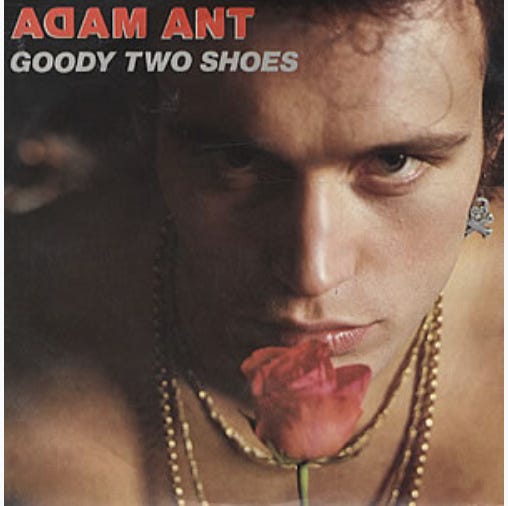
That’s not me being a Pollyanna, goody-two-shoes.
That’s what the law, and the courts, including the U.S. Supreme Court, have said since I was in accounting school.
The U.S. Supreme Court, United States v. Arthur Young & Co., 465 U.S. 805 (1984), Decided: March 21, 1984:
By certifying the public reports that collectively depict a corporation’s financial status, the independent auditor assumes a public responsibility transcending any employment relationship with the client. The independent public accountant performing this special function owes ultimate allegiance to the corporation’s creditors and stockholders, as well as to the investing public. This “public watchdog” function demands that the accountant maintain total independence from the client at all times, and requires complete fidelity to the public trust.
Auditors are required to exercise appropriate professional skepticism, gather sufficient appropriate audit evidence, adequately document work, and, particularly when there are red flags, require more sufficient evidential matter than representations from management. Auditors perform a key role on behalf of shareholders and capital markets in providing oversight of management’s financial reporting and they must perform that role with a skeptical eye and required independence and objectivity.
Over the last 40 years that I have been an accountant and CPA, in all kinds of accounting and auditing roles in industry, at banks, as an internal auditor in industry and of the firm itself including auditor independence compliance and business alliances at PwC, and an MD technology consultant at KPMG/Bearing Point and independently with P&L responsibility, as an academic, and now as a journalist with subject matter expertise, I have witnessed calls for tightening the auditor independence rules, then relaxing them, then strengthening them again, and now seeking to relax them again.
In 2020, in a four-part series here at The Dig on the state of auditor independence regulation, I quoted Barbara Roper, the former director of investor protection for the Consumer Federation of America, and an advisor to the SEC during the Biden/Gensler administration. She told me in an interview:
“Investors value audit opinions only if the auditors are independent. But audit firms have time and again shown they are either unwilling or unable to meet that most basic of standards.”
In an interview with Mark Maurer in the Wall Street Journal on December 8, 2025, EY partner now SEC Chief Accountant Kurt Hohl made the latest call for “modernizing” auditor independence rules. Hohl promised changes were not contemplated, yet, despite what he called the pressures on the global audit firms as a result of the growth of business alliances with the new AI companies:
WASHINGTON—The Securities and Exchange Commission is evaluating whether to change rules around conflicts of interest for auditors and their clients, how its audit watchdog handles inspections of accounting firms and the cost for companies of complying with requirements…
Maurer: What do you want to see change with the SEC’s auditor independence rules? The regulator last eased these rules in 2020.
Hohl: The independence rules are fairly clear. You can’t have direct business relationships with audit clients. Where it gets complex is where you basically are partnering with a nonaudit client and that nonaudit client uses an audit client as part of their service delivery. That’s what adds complications to the situation. Looking and seeing how pervasive that is, looking and making sure and talking with firms to understand how that affects how they monitor and enforce their independence requirements is something that’s top of mind.
There are complications that AI adds to the business development relationship required under the auditor independence rules. Also private equity is buying some of these smaller accounting firms and making the decision that we don’t want to serve in the public company market anymore because it’s too expensive for us to operate in that space. Auditor choice is a priority. We want to make sure that companies accessing the public markets—we’re trying to encourage companies to come to the marketplace—have a choice of audit firms in which to pick from.
There’s nothing in the works to loosen the independence rule. But we want to take a look at how the changing business environment affects our independence rules to make sure that they continue to be fit for purpose in the environment. We’ll work closely with the commission in terms of our observations and how they apply to the current rules, and we’ll decide what to do at that time.
Then, in a shameless nod to the masters Hohl apparently actually serves, Hohl tells us why he plans to relax auditor independence rules now:
Maurer: What would a potential change to auditor independence rules look like?
Hohl:I talk to the private-equity firms all the time. Some of the things that I did in retirement was actually consult for PE firms. The focus was, hey, look, if you’re going to do this, there’s a cost to basically build a high-quality audit practice that serves the public markets. You have a lot more rules that you have to comply with and the expectation is the work that’s going to be done is going to be the highest quality standard.
That’s one of the things that I talk to PE firms about. If you’re going to do this, you’ve got to go all in in order to make the investments that are necessary to serve that marketplace and encourage them to stay in because we want competitive options available.
(I wonder what other things Hohl talks to the private equity firms about.)
Hohl is referring here to the rush by private equity firms over the last few years to roll-up and invest in public accounting firms and the evidence these firms are more interested in the firms’ advisory and tax practices than their public company audit practices.
Hohl’s predecessor as Chief Accountant, Paul Munter, warned auditors who serve listed companies to be careful when private equity comes calling.
“It is of paramount importance that public accounting firms foster a culture of ethical behavior with respect to all aspects of their professional responsibilities, including auditor independence.
As we noted at the outset, high-quality audits are critical to the process of disclosing financial information for the benefit of investors and serve an important gatekeeping function to help protect investors by ensuring that issues are promptly identified and addressed. The Commission has long-recognized that audits by professional, objective, and skilled accountants that are independent of their audit clients contribute to both investor protection and investor confidence.
Any perceived erosion of auditor independence or the profession’s ethics or integrity breaks down the critical gatekeeper role of public accountants and can, over time, lead to diminished investor confidence.”
The Critical Importance of the General Standard of Auditor Independence and an Ethical Culture for the Accounting Profession, Paul Munter, Acting Chief Accountant, June 8, 2022
And, yet, Hohl’s solution to the conflicts that are inherent in taking on the profound responsibility to investors for auditing public companies, for accepting the privilege of the government-sponsored franchise provided by securities laws that requires a PCAOB-registered audit firm to sign all opinions filed with the SEC by issuers, is to suggest independence rules that prevent conflicts of interest for private equity firms who invest in public accounting firms are in the way of capitalism.
The U.S. audit watchdog should rescind its rules around conflicts of interest for auditors and their clients and follow the Securities and Exchange Commission’s rules, which the securities regulator may change, an SEC official said.
The SEC plans to weigh revising auditor independence rules over the next year, starting with releasing informal, nonbinding guidance based on companies’ recurring questions, Chief Accountant Kurt Hohl said backstage at a conference Thursday.
The “backstage at a conference” reference gives me an opportunity to note as an aside the performative practice of reporting on government officials and their utterances that I used to hate when I worked for MarketWatch in DC.
Did Hohl say more than what he said on his panel to a select few reporters invited backstage afterward in a “gaggle” or a “scrum”?
A media scrum is a chaotic attempt by a swarm of reporters to interview or photograph a celebrity, athlete, politician, etc, typically after formal remarks at a conference or event. Via the Christian Science Monitor:
When is a briefing not a briefing? When it is a gaggle. Anyone who didn’t already know gaggle got a chance to learn it Feb. 24. The meeting White House press secretary Sean Spicer held in his office that day instead of the usual daily live televised session in the White House briefing room was called a “gaggle.”
It made headlines because of who was excluded: The New York Times, the Los Angeles Times, CNN, BuzzFeed, Politico, The Guardian, and the BBC.
Gaggle sounds like fun. But its etymology should give defenders of press freedom pause. The word goes back to the late 15th century, the Online Etymology Dictionary reports. It was used “with reference to both geese and women (on the notion of ‘chattering company’).” The word may come from an Old Norse word for small goose or gosling.
In my experience, these post-formal remarks are push and shove matches that allow officials to posture and feign superiority over journalists, by deigning to provide access. Journalists are supposed to be deferential, which I have a hard time mustering. The access is available only to those invited, in the formal credentialed press contingent, and typically either provides no new content or very specific content the official wants to leak to select journalists. I have seen journalists not ask anything, stand around, and then wait for the permissioned walk down the hall with the official where the private questions and the answers don’t get heard by everyone else.
In this case, Hohl broke news in the gaggle, or at least provided a scoop the WSJ thought was important enough to repeat in a same day story.
Whatever…
So, why was Hohl so anxious to talk with journalists backstage after the Baruch panel? What is his motivation for stepping up activity now on relaxing auditor independence rules by rescinding any specific rules implemented by the PCAOB?
Hohl told the gaggle his motivation for making changes now is the potential conflicts that are developing between the largest audit firms. All of the big global audit firms are promoting near-total automation of the audit process by AI software from OpenAI, Anthropic, and Microsoft, while also signing business alliance agreements with those same companies to market the software and tools to their advisory and tax clients.
Rescinding the PCAOB’s rules could be followed by the SEC updating the rules to consider more complex issues, such as the effect of companies’ use of artificial intelligence agents in their financial reports on auditor independence, Hohl said.
The rules Hohl and his fellow EY-related regulators want to squash include one that has been around since even before Sarbanes-Oxley: Business Alliances
Rule 2-01 (b) of Regulation S-X (17 CFR 210.2-01.), amended under Sox to enhance auditor independence after the Enron/Arthur Andersen, provides the standard used to judge a business relationship between a company and its auditor or services provided to an audit client. Does the relationship create a mutual or conflicting interest between the accountant and the audit client? Examples of apparent and actual violations of the business alliance rules: EY/PeopleSoft, PwC/Thomson Reuters, Deloitte/ Autonomy/HP, PwC/Oracle GRC (Sprankle Case)
Violations of the business alliance rules led to the EY PeopleSoft enforcement action, which happened after SOx was passed but covered activity from the pre-SOx period. EY was banned from taking on new business for six months!
I identified the AI-related business alliances and the conflicts for the auditors of existing issuers and future IPOs like Anthropic and OpenAI.
You can now add that EY is likely the one signing Anthropic’s audit opinions in its pre-IPO state, that is if retired EY partner Kurt Hohl is still expecting any of the firms to follow existing law.
But there is more to this story.
The motivation for auditor independence relaxation also includes the enormous influence of private equity on the accounting industry and the related inherent conflicts that have already developed, as Hohl noted back in December to the WSJ. But there is another big issue that has been a lingering irritant to the largest global firms because it presents a regulatory enforcement risk, in particular for EY, the home firm of Hohl as well as PCAOB Chairman Jim Logothetis and FASB Chair Rich Jones. (The trio were referred to as the “EY Mafia” by one journalist that covers them.)
That lingering issue is tax services.
The easiest way to clear the path for the Big 4 global audit firms to offer any tax services, including contingent, value-based services, to any client, including audit clients, is to eliminate the PCAOB’s rules.
The PCAOB’s rules primarily adopt the original AICPA auditor independence rules that apply to everyone, whether signing audits for listed issuers or private companies and entities adopt to Generally Accepted Auditing Standards (GAAS) — the standards the PCAOB inspects and enforces against. Subsequent PCAOB GAAS rules clarify vague, compromise rules agreed to in the Sarbanes-Oxley Act in 2002 for auditors of public issuers and auditors of broker-dealers, in particular with regard to tax services.
These things take a long time to finalize, but that is by design not by default.
The PCAOB also gained responsibility for inspecting and enforcing GAAS for the auditors of broker-dealers, whether public or private, as a result of the Dodd-Frank Act in 2010. However, we are still operating under an “interim” program all tyhese years later and the auditors of broker-dealers are still fighting the PCAOB about the independence rules they are supposed to comply with.
There is a new proposal to finally finalize the program. Yeah, sure.
Since then, the board has been intermittently working on a rule proposal for a permanent program but has continued to experience delays. It is unclear exactly what the hold-up has been during previous leaderships, though there have been difficulties in figuring out the best way to shape the program.
Now, Securities and Exchange Commission (SEC) Chief Accountant Kurt Hohl wants the PCAOB to act. The SEC has oversight authority over the audit regulatory board.
“One of the things that we’ve asked the PCAOB to do is finalize their broker-dealer inspection program, so it’s no longer an interim but a finalized program,” Hohl said at the SEC Speaks 2026 conference hosted by the Practising Law Institute on March 20 in Washington.
Hohl did not provide details and did not take any questions from reporters after his panel discussion.
Kurt Hohl’s ultimate goal now is to relax the SEC’s own auditor independence rules, after getting rid of the PCAOB’s. From the WSJ on May 7:
Included in these broader plans is the potential end of separate independence rules from the Public Company Accounting Oversight Board, which the SEC oversees.
“They’re not really necessary, to be honest,” Hohl said. “If they rescinded their rules, they would rely on the SEC independence rules.”
The SEC, not the PCAOB, is ultimately responsible for setting independence rules, and it eased them in 2020. Auditors are intended to be objective assessors of financial information.
The PCAOB established independence rules using Association of International Certified Professional Accountants standards when it launched in 2003. Those rules, which some investors and regulators have criticized for being too industry-friendly, remain largely untouched from when the AICPA wrote them in the 1980s and ’90s.
“Some of those are actually in direct conflict with some of the more recent independence rules,” Hohl said, adding that creates unnecessary challenges for companies and auditors. “So we’ll get them to probably do something later this year on that.”
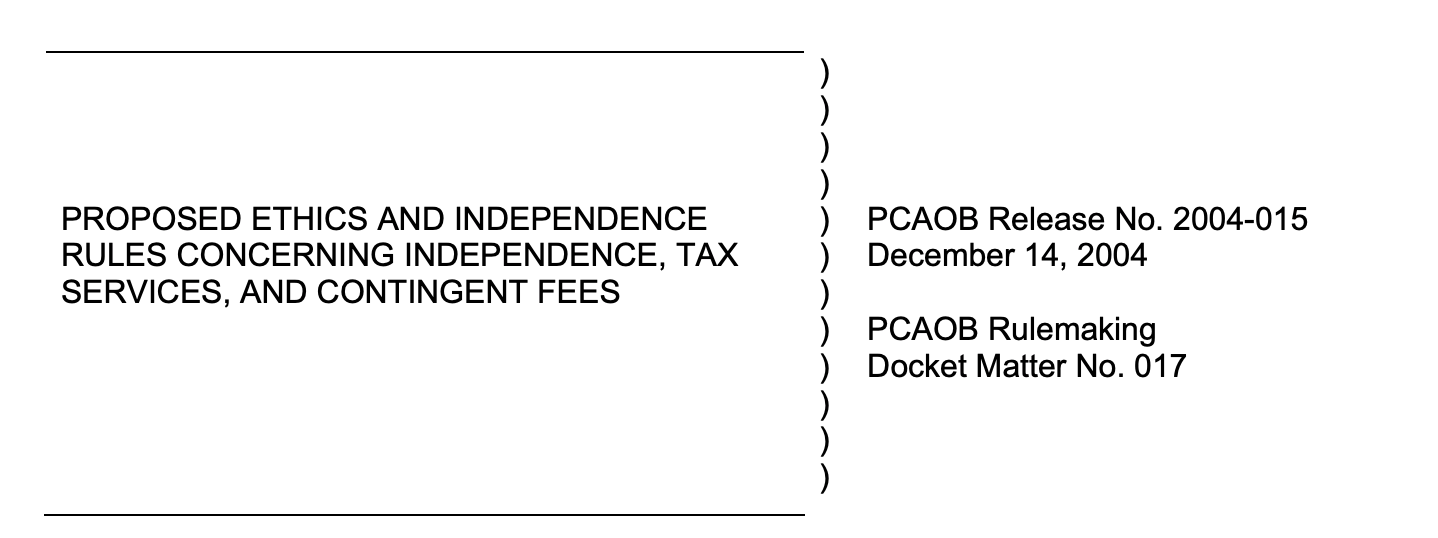
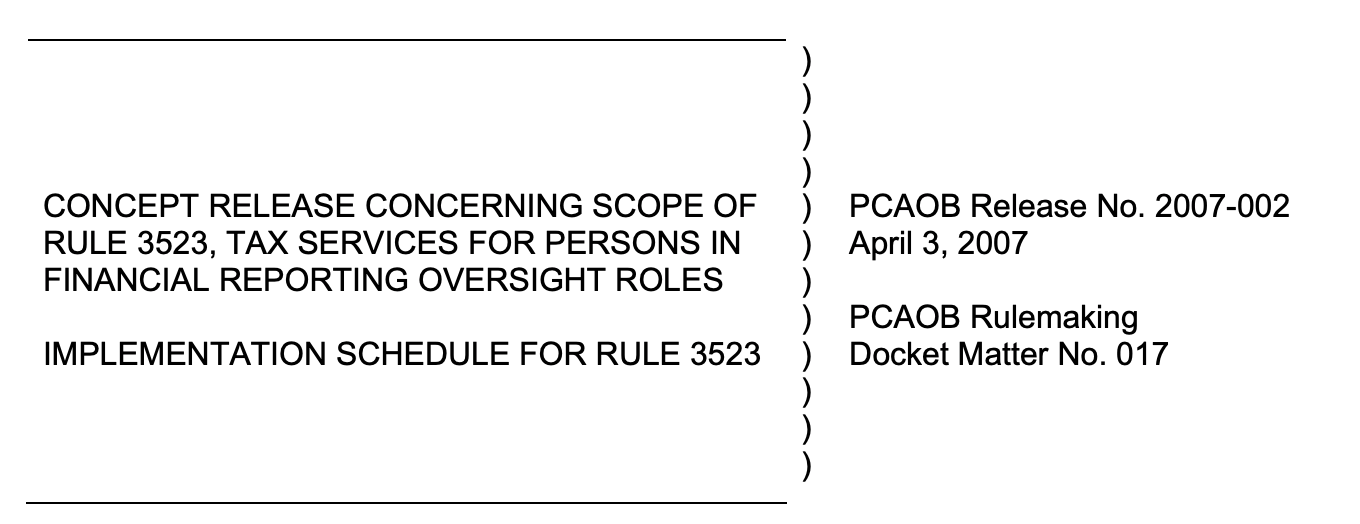
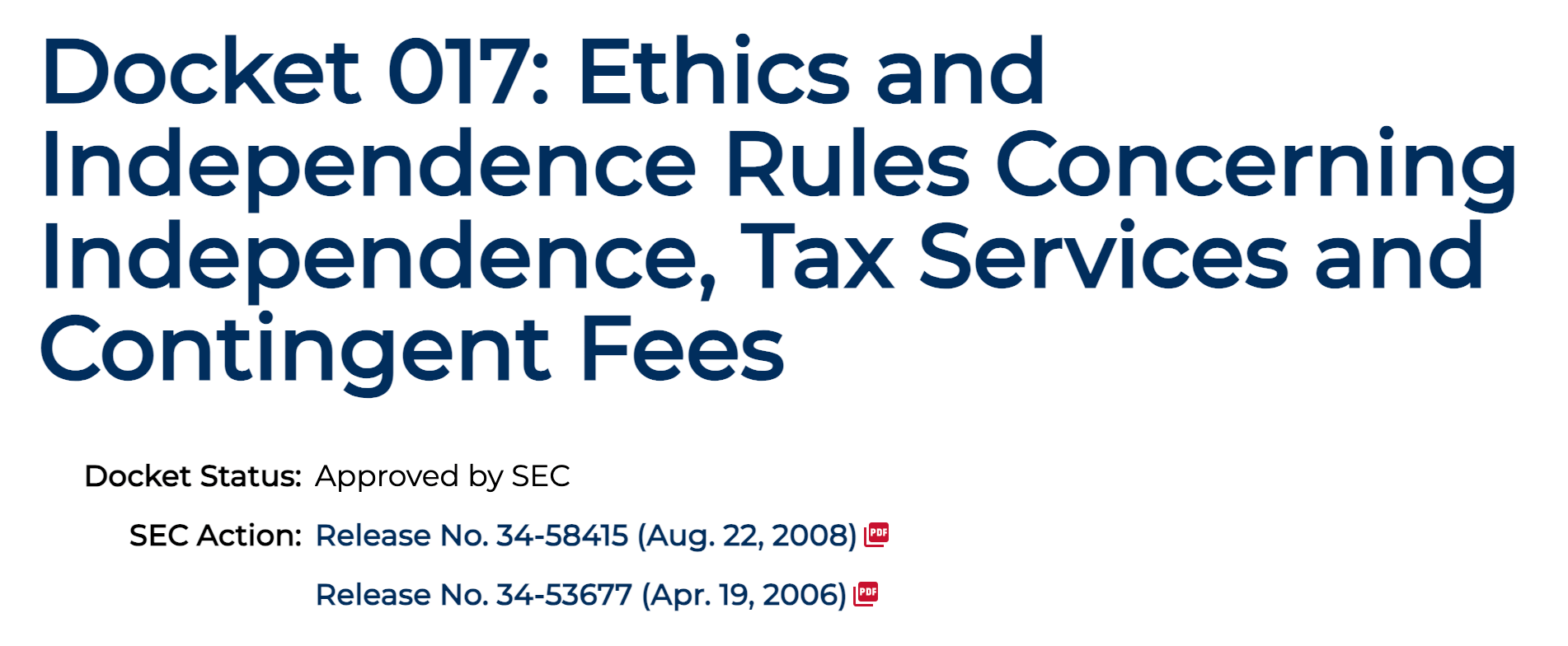
The PCAOB has made certain updates to its own rules, particularly related to tax services in 2005. Auditors are banned from providing tax services for contingent fees or commissions to public-company audit clients. It is unclear if rescinding the PCAOB rules would reopen the door for auditors to sell aggressive tax shelters to audit clients and charge them contingent fees.
The justifications for weakening the auditor independence rules are recycled, just as the need to strengthen them again periodically is created by the recurring commercialism vs. professionalism pressures. Regulators go through cycles of enforcement only to peter out again. The same rationales for relaxing the rules — dressed up by some new business model or innovation that “changes everything” — are reused every time the Big 4 want more ways to get a bigger piece of the client’s wallet — as we used to say at KPMG Consulting.
This time the same lame excuses about the need and free market obligation to encourage and support the global audit firms in their pursuit of new sources of revenue are being trotted out again. This time though, the Big 4 has hit the jackpot, because it has taken over the regulatory infrastructure with three retired EY partners in the three top industry regulatory roles. The Big 4 can finally have their way with no more meaningful obstacles.
They won’t dismantle everything completely. Regulation can benefit the regulated.
In his “Economic Theory of Regulation,” George Stigler demonstrated, for example, that major transportation regulations benefitted incumbent firms in the trucking industry at the expense of new entrants. He used these findings to argue more broadly that “regulation is acquired by the industry and is designed and operated primarily for its benefit.”
When the next “big one” hits, it will be good to have the PCAOB to blame.
Hohl and his colleagues commit a capitulation to commercialism rather than make any effort to preserve whatever professionalism is left.
“Let’s loosen the rules, beyond the overall lack of enforcement of the ones that are still in force, to give the Big 4 audit firms, and private equity firms, a clear path to profit while disregarding the firms’ public duty.” Imaginary discussion at the CAQ.
Hohl and the PCAOB’s Logothetis, in particular, and the Big 4 leaders in general are not concerned about this Paul Atkins/Donald Trump SEC prosecuting the audit firms that provide prohibited tax services, for example, to audit clients. Auditor independence conflicts, especially the conflicts of interest related to the provision of tax services to audit clients, are rarely prosecuted in any administration, libertarian/anti-regulatory or reform-minded.
For starters, it’s a great scoop. Someone told Dave about the SEC investigation and he had the exclusive and likely exclusive follow-ups. Someone wanted this investigation to be known, but the SEC and the audit firms are not yet talking about it publicly. Second, the investigation is being led out of Miami.
The SEC’s Miami office last year sent letters seeking information about client work that could cause auditors to violate rules requiring they be independent of clients whose finances they inspect, sources say. They say the letters were sent to some smaller accounting firms as well as the big four: Deloitte & Touche, Ernst & Young, KPMG and PricewaterhouseCoopers.
The Big 4 firms either declined to comment or ignored his requests for comment.
Spokesmen for the SEC, KPMG and PwC declined to comment. A spokeswoman for Ernst & Young and a spokesman for Deloitte did not respond to requests for comment.
Michaels says in his story that the SEC’s Miami office asked the audit firms for information about all non-audit services for audit clients — information that is readily available to the SEC via issuer proxies, the PCAOB inspection data gathering process, and research firm Audit Analytics — but also for information on any cases in which the firms obtained contracts that reimburse them for losses caused by lawsuits over their work, or made fees contingent on a particular result or outcome, the sources say.
Typically, a high profile investigation, one that touches the core of the Big 4, would be led by SEC HQ in DC. For example, the 2019 PwC independence-related enforcement action that Dave mentions, where PwC paid $7.9 million in fines, was led by two SEC attorneys who are both based in Washington, D.C..
The 2014 KPMG case Dave mentions, where the firm paid $ 8.2 million to settle an SEC investigation that alleged it provided prohibited non-audit services such as bookkeeping to affiliates of audit clients included a report of a non-prosecuted investigation that was a direct result of my reporting.
It’s been almost three years since I first broke the story of KPMG’s loaned tax staff arrangement with audit client GE. On January 24 the Securities and Exchange Commission (SEC) announced an $8.2 million settlement with KPMG over violations of auditor-independence rules. KPMG’s settlement includes pay back of some fees earned on the illegal services and some fines. The wheels of justice turn very slowly. Unfortunately, none of the companies involved were named…
I hope you will join me for Part 2, where I will provide some more history and context for this discussion and then tell you what’s really behind the push this time, supported by data.
Part 2 will be behind the paywall, so please consider becoming a paid subscriber to The Dig.
The Dig is a reader-supported publication. To receive new posts and support my work, consider becoming a free or paid subscriber.